Our object is the promotion of literary and scientific culture
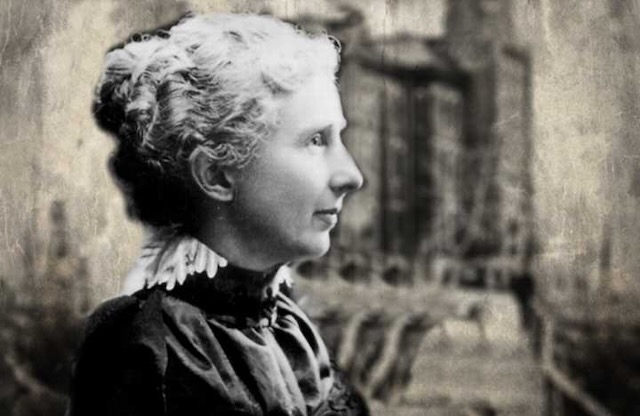
This photo of Mary Rippon was taken in 1899. One hundred years later, Sylvia Pettem put it on the cover of her book “Separate Lives: The Story of Mary Rippon”, 1999.
Ms. Pettem used it courtesy of the Heritage Center, University of Colorado.
history of Boulder Fortnightly
by Susan Boucher
In 1873, Isabella Bird said, “Boulder is a hideous collection of frame houses on the burning plain, but it aspires to be a city.” It may have been a hideous collection of frame houses, but Boulder not only aspired to be a city, it went to a great deal of effort to become the home of the University of Colorado. And because of the intelligence and curiosity of some of the women associated with or married to the university, it became, as well, the home of Fortnightly. During the last quarter of the 19th century, a large number of women’s clubs sprang up across the country, many in college and university towns. At a time when few married women worked, some, seeking intellectual and cultural stimulation, invited like-minded friends to form women’s literary clubs.
Because Wyoming and Colorado were the first two states to grant suffrage to women, it is not altogether surprising that more than one third of the students at the university in the first semester were female. And it’s therefore, perhaps, just as unsurprising that among the first faculty members was 27-year-old Mary Rippon, the first female professor in the West, and one of the first in the country to teach at a state university. She was not only professor of Romance Languages and German, and the unofficial Dean of women, but the University of Colorado’s unofficial landscape architect as well. Perhaps inspired by Isabella Bird’s reference to the “burning plain,” she planted grass, flowers and shrubs around Old Main, which, at the time housed the administrative offices, classrooms, the chemistry lab, the chapel, library and living quarters for President Sewall and family.
What with all that gardening, teaching and mentoring, one would have thought Mary Rippon had more than enough to keep her busy. In 1884, however, it was she, along with a pair of professors’ wives who’d been members of a ladies’ study club in Michigan, who founded what came to be known as the Fortnightly Club of Boulder. Today it is one of the oldest women’s literary clubs in Colorado, established only three years after the Denver Fortnightly Club.
As many new organizations tend to, the ladies bit off a bit more than they could chew at first. (Indeed, in a history of Fortnightly, written by Rippon in 1930, she remembers that many of the early meetings were hampered by too many and too long programs. ) Topics were assigned, and at each meeting three to four papers were read and exhaustively discussed. That first year, in recognition of Miss Rippon’s recent return from and interest in Italy, the topics were: the reading of George Eliot’s Romala, Grimm’s Life of Michaelangelo, an 1,100 page two-volume tome, plus study of the history and art of Florence. A few years later the format was expanded with the addition of occasional evening Parlor Lectures, often given by professor husbands of members. Lectures were followed by musical performances and refreshments.
As today’s members do, the original members led busy lives, but to quote one of them who reported to have read while washing dishes, churning, knitting and chasing her offspring, “A woman finds time for what she likes best.” Study topics were printed in the newspaper and were, according to Mary Rippon, “often read with interest by ladies in the mountains or in the country and now and then we learned of someone who, without making herself known, had studied with us the whole year.”
Generally, members had available only their own and each other’s home libraries or the university library, which required climbing, while holding onto a rope railing, up the hill to Old Main from what is now University Avenue. So it made sense that the ladies of Fortnightly in Boulder, like many of the Fortnightly clubs across the country, began collecting books and campaigning vigorously for a public library. Thus began the tradition of donating to deserving causes, which, in the early years included a significant contribution towards the acquisition of the organ in Macky Auditorium, and for many years maintaining a room in the Boulder County Hospital.
While we still meet on the first and third Thursdays, October through May, and donate to deserving causes, Fortnightly has changed over the decades. We no longer have an assigned topic, but rather an overarching theme that guides each two-year cycle. Instead of three or four papers, members present an original 30-40-minute paper every other year. Instead of meeting on the second floor of the old First National Bank Building, we now generally meet in members’ homes with the paper followed by refreshments similar to a high tea. Instead of addressing each other as “Mrs.” or “Miss,” we use first names. Instead of pens or typewriters, we now use computers. Despite changes, however, the quotation that guided the year 1891-1892 is as relevant today as it was then: “The more things thou learnest to know and enjoy, the more complete will be for thee the delight of living.” We still believe that to be the case, and we’re most grateful for the company of knowledgeable, enjoyable and delightful women.
 The Fortnightly Club of Boulder